Artemis Generation Plans Lunar Return as ISS Reaches 20 Years of Continuous Human Occupation
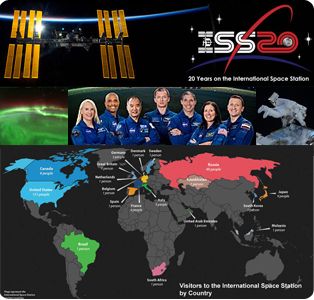
Expedition 64 with Sergey Ryzhikov, Sergey Kud-Sverchkov and Kate Rubins will celebrate ISS passing its 20th full year / entering the 21st of continuous human occupation November 2. Victor Glover is set to become the 242nd person to visit ISS as part of SpaceX Crew-1 mission mid-Nov and would be the 1st Black Astronaut to join a long-term ISS crew. From an average altitude of ~400 km, ISS orbits Earth 16 times a day – nearly the same distance to the Moon and back. Capable of docking 8 ships at once, there are 4 craft which deliver cargo (Progress, HTV, Cygnus, Dragon) and soon to be 3 qualified for humans (Soyuz, Dragon, Starliner). More than 3,000 research investigations have been conducted from 108 countries, with ~200 ongoing any given day. 20 payloads can be hosted externally including Earth sensing equipment, materials science payloads and particle physics experiments such as Alpha Magnetic Spectrometer-02. A total of 231 spacewalks (equaling 1,439 hours and 49 minutes) have been performed, the longest of which was March 2001 by STS-102 crew Susan Helms and James Voss at 8 hours 56 mins. There are >50 computers and 350,000 sensors monitoring crew and station health. While only 19 countries have sent people to ISS, perhaps the Artemis Program will represent more of the nearly 8 Billion people / 250+ countries and territories on Earth. (Image Credits: NASA) |
MONDAY Highlights…
|
 Oct 26 —
  Oct 26 — NewSpace: Intuitive Machines awarded US$47M to deliver
  Oct 26 — USA:
 = All times
for terrestrial events in local time unless noted.
 = All times for international terrestrial events in local time unless noted.
 = All times for space events, and…
 = All times for international space / astro events in Hawaii Standard Time unless noted. Add 10 hours to obtain UT (‘Universal Time’).
Weekly Planet Watch – Evening Planets: Mars (SE), Jupiter (WSW), Saturn (WSW), Uranus (E), Neptune (SE); Morning Planets: Venus (E).
India Approaches Major National Space Program and NewSpace Milestones
|
Oct 26 — STEREO (Solar Terrestrial Relations Observatory) A & B, Heliocentric Orbit: NASA craft imaging Sun and solar phenomena reach 14 full years / enter 15th year in space today, launched 2006.
Continued From…
TUESDAY
|
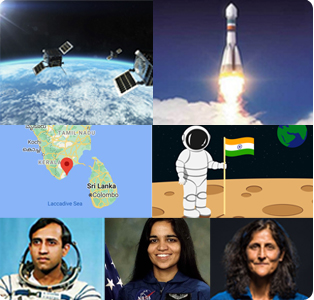 ISRO aims for an early November return to flight with PSLV-C49, the 76th launch from Satish Dhawan Space Centre. Utilizing PSLV-CA (Core Alone) configuration, RISAT-2BR2 Synthetic Aperture Radar earth observation satellite (companion to RISAT-2) and international rideshare payloads are to be lifted to 37-degree inclination orbit. Launch subcontractor Spaceflight Inc. of Seattle is providing logistical support to Kleos Space of Luxembourg, on location in Sriharikota. ‘Kleos’ Scouting Mission’ to insert the first 4 Radio Frequency Reconnaissance smallsats of future constellation. Small Sat Launch Vehicle (SSLV) inaugural flight is to follow from the same site, after launch pad retrofitting to suit the ‘Baby PSLV’ geared for commercial needs. The 34-m SSLV is to have payload capacity of 500 kg to LEO and 300-kg to SSO, and will be marketed by NewSpace India Limited, a commercial arm of ISRO for ~US$16.3M. A new spaceport in Kulasekarapattinam, Tamil Nadu, which will accommodate a due south trajectory (saving fuel that would otherwise be spent avoiding Sri Lanka downrange) is under construction to accommodate what is hoped to be regular, 2-3x monthly launch activity. Indian Human Spaceflight Program strives to realize Gaganyaan, with two orbital test flights (1,2) and crewed flight (3) set to send 1-3 Gaganauts to space by Aug 2022. India is also determined to robotically explore the Lunar surface with Chandrayaan-3 in the coming year. (Image Credits: NASA, ISRO, Google)
 Oct 27-30 — APRSAF, Vietnam Academy of Science and Technology, Hanoi, Vietnam: 27th Asia-Pacific Regional Space Agency Forum (APRSAF-27); reset to one day event on Nov 19.
Oct 27 — Moon: 4.0° SE of Neptune, 00:00.
Oct 27 — Apollo Asteroid 2020 TD8: Near Earth Flyby (0.004 AU)
Oct 27 — Apollo Asteroid 2020 TQ2: Near Earth Flyby (0.042 AU)
Oct 27 — Aten Asteroid 2005 UV64: Near Earth Flyby (0.049 AU)
WEDNESDAY
Oct 28 — LPI, USRA, NASA, Online / Houston TX: Lunar Surface Science Workshop 5: Science Enabled by Mobility.
Oct 28 — JAXA, IAF Global Networking Forum, Online: Global Exploration Roadmap – Supplement August 2020, Lunar Surface Exploration Scenario Update; 14:00-14:30 CET.
Oct 28 — Debevoise & Plimpton LLP, Online / New York NY: Online Seminar: The New Space Race – International Space Law in the Public and Private Sector; 13:30-15:00 EDT.
Oct 28-29 — Secure World Foundation, Consortium for Execution of Rendezvous and Servicing Operations (CONFERS), Online: 2020 Global Satellite Servicing Forum.
Oct 28 — Apollo Asteroid 2020 TR5: Near Earth Flyby (0.010 AU)
Oct 28 — Aten Asteroid 2020 UN1: Near Earth Flyby (0.011 AU)
Oct 28 — Apollo Asteroid 2020 TM7: Near Earth Flyby (0.014 AU)
Oct 28 — Apollo Asteroid 2020 TS5: Near Earth Flyby (0.024 AU)
THURSDAY
Oct 29 — Johns Hopkins Applied Physics Lab, Online / Laurel MD: Lecture: The Extra-Galactic Background Light: Opening a Window to Early Galaxy and Star Formation.
Oct 29 — Moon: 2.72° SE of Mars, 09:00.
Oct 29 — Apollo Asteroid 2020 OK5: Near Earth Flyby (0.016 AU)
Oct 29 — Apollo Asteroid 2020 TR2: Near Earth Flyby (0.023 AU)
FRIDAY
Oct 30 — Intrepid Sea, Air & Space Museum, NYC NY: Astronomy Nights: Deep Field – Views from the Hubble Telescope; film featuring Hubble Space Telescope.
Oct 30 — Brazilian Space Agency (Agência Espacial Brasileira / AEB), Online / Brasilia, Brazil: Final proposals for launch license applications due from companies and agencies interested in utilizing Alcantara Spaceport, Brazil.
Oct 30 — Moon Village Association, Online: Final Presentation Due: 1st Online Global International Moon Village Workshop & Symposium; with a special focus involving African and Middle-Eastern countries; being held Nov 9-10.
Oct 30-31 — Space Generation Advisory Council, Madrid, Spain: 5th European Space Generation Workshop: Space for Earth and Humanity; reset to May 28-29, 2021.
Oct 30 — Moon: At apogee (distance 406,416 km), 09:00.
Oct 30 — Venus: At perihelion, 0.7184 AU from Sun, 13:00.
SATURDAY
Oct 31 — CNSA, Ministry of Education, Ministry of Science and Technology, Chinese Academy of Sciences, Online / Beijing, China: Last day for students to submit ideas for payloads for Chang’e-7 lunar south pole craft, and ZhengHe mission that will return samples from Asteroid 469219 Kamoʻoalewa (2016HO3) and visit Comet Elst–Pizarro (133P).
Oct 31 – Nov 3 — Space Foundation, Colorado Springs CO: 36th Space Symposium; reset to Aug 22-26, 2021.
Oct 31 — Moon: Full / Hunter’s / Blue Moon, 04:50 – next Halloween Full Moon to occur 2039; 2.98° SE of Uranus, 06:00.
Oct 31 — Uranus: At opposition, magnitude 5.7, 06:00.
SUNDAY
NET Nov — InSight, Mars Surface: Scheduled end to planned Mars surface operations mission; future plans / goals / extension to be determined.
NET Nov 1 — SpaceX, Launch Falcon 9 / NROL-108, SLC-40, Cape Canaveral AFS: SpaceX Falcon 9 rocket to launch classified spacecraft payload for U.S. National Reconnaissance Office.
Nov 1 — Deep Space, Very Local Interstellar Medium: Voyager 2 confirms increased plasma density outside of heliosphere as first observed via Voyager 1, future readings will aid data.
Nov 1 — Standard Time (USA): Change clocks back 1 hour from Daylight Saving to Standard Time; does not include Hawai’i, American Samoa or Arizona (except the Navajo Reservation).
Nov 1 — Mercury: 4.0° NE of Spica, 10:00; at perihelion, 0.3075 AU from Sun, 17:00.
