First Women / Americans at the Moon South Pole 2020-2021Open Letter to the Trump-Pence Administration
|
MONDAYOngoing…
|
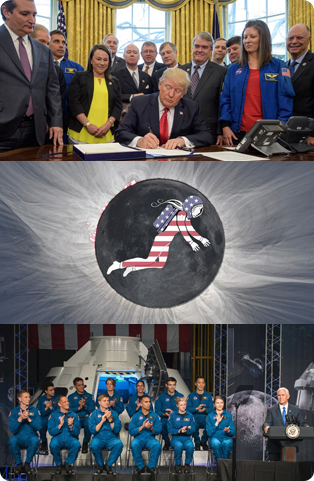 Tenancy on the Moon by Women and Men as soon as 2020 is within reach and would be a noble and valuable objective for American greatness. The Moon’s South Pole is a 21st Century New Frontier as pioneering and enriching as Humans on Mars and trillion dollar asteroids, and much closer in time and space. India and China are advancing strategic campaigns to the Moon focused on material and energy resource growth. A Cislunar Superhighway could be a defining USA / international 21st Century infrastructure investment. Launches of humans to Space from American land again are highly anticipated. Vice President Pence just greeted the new Astronauts including Loral O’Hara, and she wonders: “Every time I look at the Moon, I think: Holy Cow, I might be walking around up there someday – that’s actually a real possibility”. NASA Space Launch System and Orion crew capsule currently in development are expected to be flying by 2019. NewSpace enterprises are also moving forward: SpaceX is preparing to test the Falcon Heavy launch vehicle and is working to develop its Dragon crew vehicle and Interplanetary Transportation System; Blue Origin is working on its New Glenn, New Shepard and New Armstrong vehicles; Bigelow continues to refine the technology for inflatable space habitats; Moon Express and Astrobotic count down to launch commercial lunar operations. The time to return “in peace for all” — to reclaim the greatest American, human advance, and for good — is now. The Moon is our launch pad to the Solar System and gateway to the Stars. (Image Credit: NASA, N. Moeller, Space Age Publishing Company)
 Jul 3 —
  Jul 3 — Global: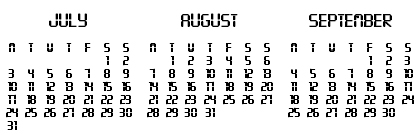
 = All times
for terrestrial events in local time unless noted.
 = All times for international terrestrial events in local time unless noted.
 = All times for space events, and…
 = All times for international space / astro events in Hawaii Standard Time unless noted. Add 10 hours to obtain UT (‘Universal Time;’ Greenwich, England).
Weekly Planet Watch – Evening Planets: Jupiter (SW), Saturn (SE); Morning Planets: Venus (E), Uranus (E), Neptune (SE).
G20 Summit Leaders Urged to Consider Space Development for Sustainable Solar System Economy in the 21st Century
|
Continued from…
TUESDAY
|
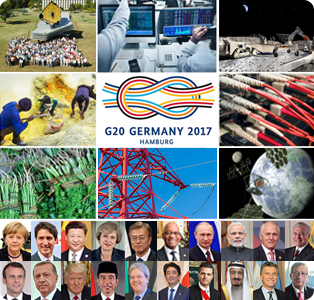 The 2017 G20 Summit “Shaping an Interconnected World” in Hamburg July 7-8 will mark the 12th meeting of the Group of Twenty (G20) for heads of state / government to coordinate international economic cooperation, stability, growth, trade and finance. Participation is expected from Germany Chancellor Angela Merkel, Argentina President Mauricio Macri, Australia Prime Minister Malcolm Turnbull, Brazil President Michel Temer, Canada Prime Minister Justin Trudeau, China President Xi Jinping, India Prime Minister Narendra Modi, USA President Donald Trump, Russia President Vladimir Putin, as well as head of Indonesia, Italy, Japan, Mexico, Saudi Arabia, South Africa, South Korea, Turkey, United Kingdom, European Union, and invited guests from Guinea, Netherlands, Norway, Senegal, Singapore, Spain and Vietnam. For the 1st time at a G20 Summit, a digital affairs ministers conference will be held to discuss technology, broadband and mobile growth. The global space industry market of 2015 was US$323B (Space Foundation “The Space Report: 2016). International Lunar Decade Working Group asks the leading industrialized nations and emerging economies of G20 to focus on global space advancement to support economic, environmental, cultural and social sustainability. Space technologies from satellites, launch vehicles, ground stations and astronomical telescopes enhance capabilities in many related industries, are increasingly important for education and employment, and provide unique opportunities for economic growth via manufacturing, commercial enterprise, and new innovative markets including space tourism, resource mining and Galaxy mapping. (Image Credit: G20, NASA, JWST)
WEDNESDAY
Jul 5-9 — University of Notre Dame, Notre Dame, Indiana: 13th Biennial History of Astronomy Workshop; featuring Professor Mike Edmunds of Cardiff University.
Jul 5 — Moon: At apogee (distance 405,934 km), 18:27.
Jul 5 — Apollo Asteroid 2017 MB5: Near-Earth Flyby (0.048 AU).
Jul 5 — Apollo Asteroid 2017 BM31: Near-Earth Flyby (0.072 AU).
THURSDAY
Jul 6 — ESA, JAXA, Noordwijk, The Netherlands: Media: Last chance to view ESA / JAXA Mercury Explorer BepiColombo; craft will be shipped to Kourou, French Guiana spaceport for October launch.
Jul 6 — Hawaii Preparatory Academy, W. M. Keck Observatory, Kamuela HI: Life in the Universe; by Abraham Loeb of Harvard University, at Gates Performing Arts Center, 19:00.
Jul 6 — Huntsville Alabama L5 Society (HAL5), Huntsville AL: Monthly Meeting featuring Omar Mireles from NASA MSFC on Additive Manufacture for Aerospace; at U.S. Space and Rocket Center Education Training Facility.
Jul 6 — Moon: 3.2° N of Saturn, 17:34.
Jul 6 — Aten Asteroid 2017 MA5: Near-Earth Flyby (0.038 AU).
Jul 6 — Apollo Asteroid 2017 MA: Near-Earth Flyby (0.057 AU).
FRIDAY
Jul 7-8 — G20 Summit, Hamburg, Germany: G20 Summit for heads of state or heads of government to discuss international economic cooperation; International Lunar Decade Working Group urges Germany Chancellor Angela Merkel to include space development as innovative, global strategy for building sustainable, long-term future for humanity.
SATURDAY
Jul 8 — Space Center Houston, Houston TX: Lunch with an Astronaut, Brian Duffy, adult US$69.95.
Jul 8 — Moon: Full (Buck Moon), 18:07.
SUNDAY
Jul 9 — The Space Show, Online / Tiburon CA: Dr. David Livingston talks with Attorney Laura Montgomery about Article 9 of the Outer Space Treaty.
Jul 9 — Tucson L5 Space Society – NSS Chapter, Tucson AZ: Tucson L5 Space Society monthly meeting.
Jul 9 — National Space Society of North Texas, Irving TX: National Space Society of North Texas monthly meeting; at Spring Creek BBQ, 15:30.
Jul 9-14 — Astronomical Society of Australia, Research School of Astronomy & Astrophysics (RSAA) at Australian National University, Canberra, Australia: Astronomical Society of Australia 2017 Annual Meeting; includes Annual General Meeting of ASA and the public Harley Wood Lecture.
Jul 9-15 — Rencontres du Vietnam, Quy Nhon, Vietnam: 13th Rencontres du Vietnam: Cosmology; and Jul 9-21 Vietnam School on Neutrino Physics.
Jul 9 — Mercury: 0.1° N of Beehive Cluster, 15:33.
